



Archaeologists in Peru Uncover 600-Year-Old Intact Chimu Royal Tomb at Chan Chan
Archaeologists at Peru's ancient citadel of Chan Chan have discovered an intact 600-year-old Chimu funerary platform containing 38 burials, gilded ornaments, and royal artifacts.





 WORLD
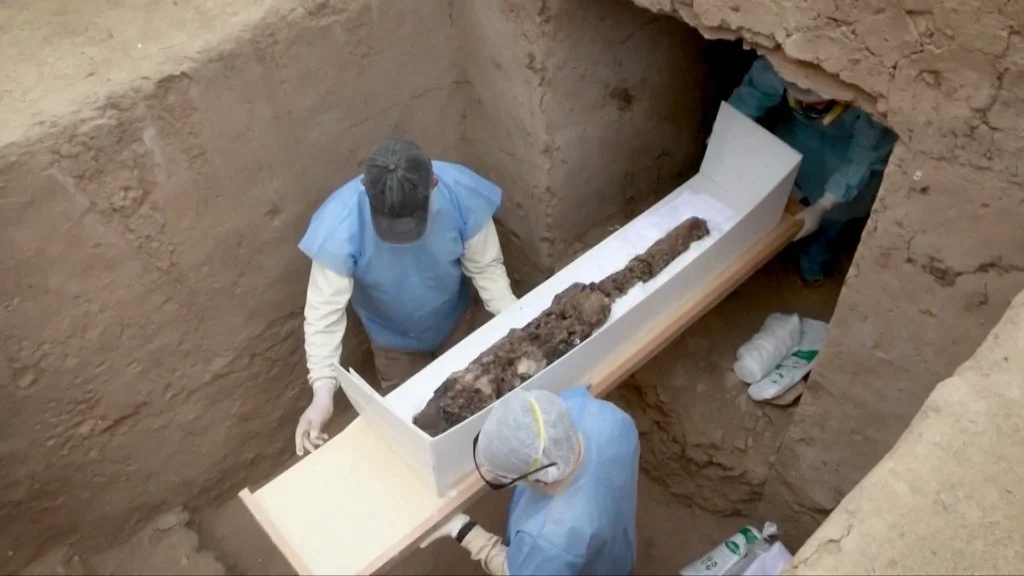
WORLDArchaeologists working at the ancient pre-Incan citadel of Chan Chan in northern Peru have uncovered a remarkably preserved 600-year-old funerary platform containing the remains of 38 individuals and an extensive cache of royal artifacts, Peru's Ministry of Culture announced.
The discovery was made in the Utzh An sector, formerly known as the Gran Chimu palace compound, located on the outskirts of Trujillo. Unlike most monumental tombs in the coastal desert region, which were looted during the colonial era or subsequent centuries, this burial site survived virtually undisturbed.
Excavations revealed a primary central chamber flanked by two symmetrical lateral rooms. Within the chambers, researchers documented human remains adorned with red cinnabar pigment—a sacred substance reserved exclusively for the upper hierarchy of Chimu nobility.
Rare Elite Artifacts and Funerary Offerings
Among the extraordinary artifacts recovered from the platform are gilded metal crowns, repousse headdresses, finely carved wooden boxes with shell inlays, and multi-strand necklaces made from turquoise, quartz, and spondylus shell.
Archaeologists also found ceremonial weapons and textiles that demonstrate the advanced craft specializations and extensive maritime trading networks commanded by the Kingdom of Chimor before its conquest by the Inca Empire in the late 15th century.
"Finding a funerary platform of this magnitude completely intact provides unprecedented insight into the elite mortuary rituals and sociopolitical structure of the Chimu state," lead researchers stated at the presentation in Trujillo.
Unusual Burial Posture Points to Possible Ritual Sacrifice
While the majority of the recovered skeletons were arranged in the traditional flexed, seated posture characteristic of Andean coastal burials, one individual was discovered lying in a fully extended position.
Bioarchaeologists and forensic teams are conducting physical anthropology analyses and radiocarbon dating to determine if this individual was buried as part of an elite sacrifice to accompany a high-ranking lord into the afterlife.
Chan Chan, recognized as a UNESCO World Heritage site since 1986, was the largest adobe metropolis in pre-Columbian America, housing an estimated 60,000 inhabitants at its height. The discovery confirms that the ancient city still holds significant treasures waiting to be uncovered by systematic conservation initiatives.
Daniel K. Harper specializes in long-form investigations, public records analysis, and institutional accountability reporting.

Just for You
 WORLD
WORLDLatin American Business Travel Spending Surges Toward Record $67.7 Billion Amid Regional Corporate Expansion
Business travel spending in Latin America is forecast to hit a record $67.7 billion in 2026, an 11% annual inc…
 WORLD
WORLDPan American Health Organization Validates Chile as First South American Nation to Eliminate Dog-Mediated Rabies
PAHO and WHO officially certified on September 29, 2026, that Chile has eliminated dog-transmitted rabies, bec…
 WORLD
WORLDUnited States Revokes Visas for 27 Latin American Officials Under Shield of the Americas Anti-Corruption Mandate
The U.S. State Department revoked visas for 27 Latin American officials and family members from Bolivia, Colom…
 WORLD
WORLDEighteen Suspects in Jovenel Moïse Assassination Extradited to United States as Judicial Cooperation Expands
Eighteen key suspects in the 2021 assassination of Haitian President Jovenel Moïse were extradited to the Unit…
Comments (0)
Sign in or create an account to leave a comment.